
I Built an Oxford Punt

Updated: Mar 24
I am lucky enough to live adjacent to the River Cherwell in Oxford. Having spent much of my life here, first at school and then studying at university, there are few things I love more than punting. For anyone unfamiliar with this peculiar pursuit, it consists of pushing oneself along a river on a punt using a very long (18-foot) pole. Often with a glass in hand or, on a rainy day, a cup of tea. A good picnic while floating on the river is hard to beat and, as students, we had many funny antics on punts.
When we moved into our house I immediately knew that I was going to want a punt and, being a bespoke furniture maker, I am long on tools but short on cash, so it seemed I was going to have to build my own. As fortune would have it, not far away I found the sunken wreck of what I assumed was an old punt on the bottom of the river, just visible beneath the surface one summer when the water level was low. I thought I might salvage it, perhaps steal a few usable parts from it or at the very least take some measurements.

As I waded in and heaved it up to the surface, to my delight I realised that the punt itself was in fact made from fibreglass. It had some holes and the wood had all rotted away but the fundamental core of the boat was sound. Furthermore, from my prior research I knew that since this boat was going to have to live in the water year round (I don’t have anywhere to lift it out and store it as they do at the local boathouses), a solid timber punt would have been entirely unsuitable as it too would rot away if left in the water for more than a couple of years.
The first step was going to be getting it out of the water. In my folly I decided the best way to do this would be to lift it straight out and onto the decking - the slight issue being the size of my garden and the ten-foot drop. I tied ropes around either end and raised it very slowly with the help of an unsuspecting friend I had invited over to lend a hand. Punts are heavy.
We raised each end a foot at a time, tying off the rope and then raising the other end. Eventually lifting it over our heads and down into the garden. It sounds simple but it really wasn’t. We were covered in river slime and shaking with the effort but, once safely installed, we sat back with a cold beer and admired our work - and finally had a chance to inspect the bottom.


Now I remember telling my wife at the beginning of this project that it shouldn’t take more than a week - maybe even less. This remains technically true: I could perhaps have made it serviceable in a week. But once it was out of the water it was only going to be out once and, if you’re doing a job, you may as well do it properly. It was nearly two months later that we made our maiden voyage (we effectively had no garden for the whole summer) but I think it was worth the wait.
The work initially consisted of stripping off all the remaining wood, cleaning it, sanding it inside and out, patching a couple of holes, coating the whole thing with epoxy and then painting it with several coats of Oxford blue yacht paint.


Then it was on to the woodwork. I used sapele for the timber, being very similar to the mahogany that would traditionally have been used but much more readily available. I needed 5.6-metre lengths for the sides which is no mean feat and, after these were delivered to the wrong address, I then had to cycle through Oxford with these lengths balanced over my shoulder. As luck would have it Oxford United had just been promoted and the streets were overflowing with revellers. I felt rather like I was jousting and might well impale any of them, but I made it home with the timber unblemished, which is what mattered the most.
Normally I would buy raw timber and machine it myself but lengths like these simply won’t fit through my workshop machinery, so I had to buy them pre-machined.
First I fitted the side rails and then filled between them with a blue epoxy to match the rest of the punt. They are screwed from the outside to keep a clean appearance on the inside. I made slats for the bottom of the punt to keep any water that inevitably finds its way in away from your feet. These have a gentle round-over and are screwed from underneath for a clean look and a soft feel underfoot.
The seat backs were made from some marine ply that my neighbour had spare. One day perhaps I will upgrade these but, since they were going to be covered with cushions, they seemed perfectly adequate for now.
Finally I made the front and back panels. At the back, where the punter stands, I included a secret compartment with hidden Soss hinges so that I could safely store a mooring rope for when we’re out and about and, crucially, a chilled compartment for drinks.
The thing that really took an age was the varnishing. As I said, I wanted to do this properly and the proper guidance for boats is fourteen coats of varnish, allowing 24 hours to dry between coats and lightly sanding between each one. Stacking so many components for so long takes up a surprising amount of space and eventually my wife had to accept we weren’t going to have a living room or garden for two weeks.

The final step was just the cushions. We had our fabric swatches well organised and the cushions were made to measure by a lovely local seamstress, Ella.
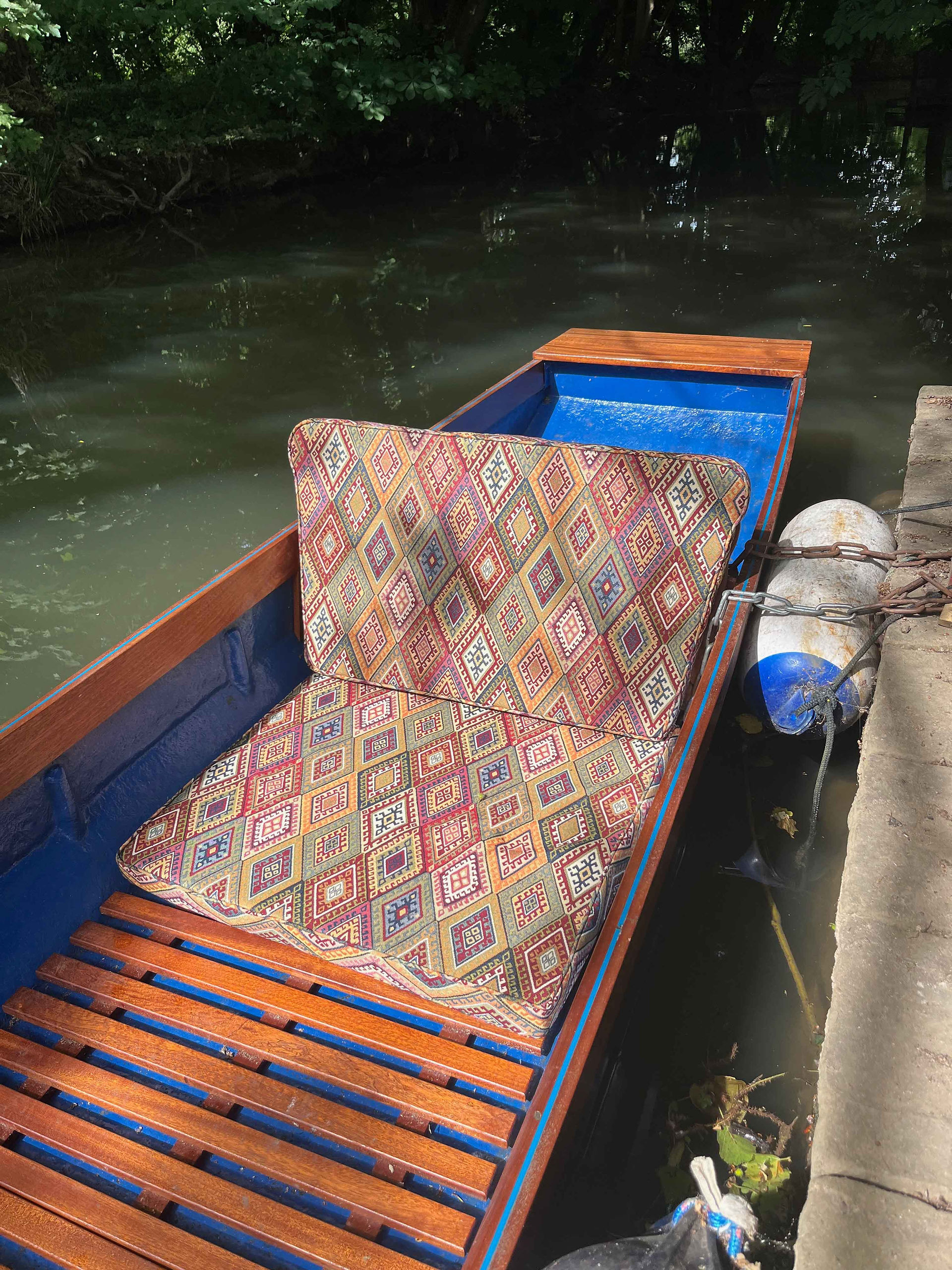

Anyway, it was all worth the wait. Late in the summer I called in the troops as I didn’t want to risk damage to the new paintwork lowering it over the side of our decking and we walked the punt round to Angel & Greyhound Meadow to slide her into the water.
It was late in the day but the next morning my wife and I set off, initially just heading to Christ Church Meadow where we could moor up and get some breakfast. I used to punt on the upper stretch of river from the Cherwell Boathouse, so the lower section from the Magdalen Boathouse was less familiar to me. Having had our breakfast and encouraged by the beautiful weather, I suggested we continue exploring up the river.

An hour or so later we reached the famous rollers at Parson’s Pleasure. I have seen old black-and-white photographs of these rollers crowded with punts and people in happier times perhaps, but I had never actually seen a punt go up or down them myself. I had to give it a try.
Being substantially fibreglass the punt wasn’t actually too heavy and in fact I was just able to heave it up the rollers by myself (my wife being eight months pregnant at the time).
From there I was on familiar territory and couldn’t resist visiting a few old haunts: first the Oxford University Parks, then the Dragon School boathouses, the Cherwell Boathouse and, naturally, as a final destination, the Victoria.
We had a long lunch with numerous celebratory drinks (on my part at least) before eventually deciding we had best get back home.
Excited by the speed and quick turning circle of this lighter punt I insisted on exploring every waterway I could find and we only made it back home as the sun was setting. I feel it was a fair tribute to the punt and that one day alone would have made the work involved well worth it.
We have since been on a great many punt trips, although my son was born only a couple of weeks after this first one which has slightly reined things in. He did go on his first punting trip at ten days old though, which I hope he will one day tell his children about. Although as an inquisitive toddler he is currently a rather alarming passenger, I have high hopes that before long he will be the one doing the punting and I can finally lie back, eat a scone, and read my book in peace.

You can read more about me and my normal line of work as a bespoke furniture maker here.


Comments